Article on the Front Page, or Straight Into the Section? What the Surcharge on a PR Publication Buys
Most media sell two variants of the same article: with front-page promotion and without it. The price difference tends to be in the hundreds, the difference in content zero – the text and the link are identical. We break down what a front-page placement really buys, how long it lasts and why for AI visibility it changes almost nothing.
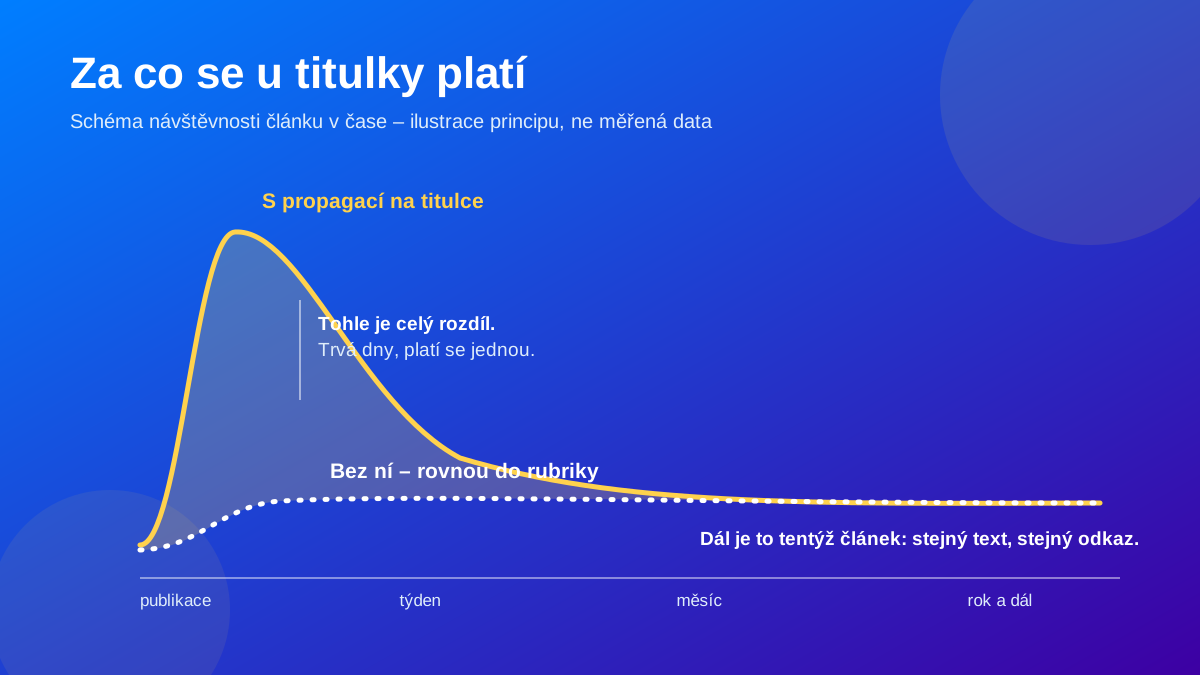
In a medium’s price list it looks like two different services. “PR article with front-page placement” for one price, “PR article in a section” for a markedly lower one. Yet the text is the same, the link is the same, the domain is the same. Only one thing differs: whether the article pops up on the front page for a few hours or days, or whether it settles straight in among the other articles in its section.
The buyer’s question is simple: is that price difference worth paying? The answer is “sometimes yes”, but for different reasons than usually stated – and for AI visibility almost never.
First let us clarify the terms, because three different things get confused
Media and marketplaces use unhappily similar words for these products. Before you start comparing prices, make sure you are talking about the same thing:
- A new article without front-page promotion. This whole article is about this. A new text is created, published into a section, and does not reach the front page.
- Inserting a link into an existing article (in the trade “link insertion” or “niche edit”). No new text is created; a link is added into an older article that has been on the site for years. A different product, a different price, different risks.
- Permanence of the publication. Whether the article stays on the site forever, or the medium deletes it after twelve months. This is an independent property of both variants above, and it is the one most often forgotten when buying.
The word “archive” is used in price lists for the first and the third meaning, occasionally for the second. It pays to ask literally: will a new text be created? where will the link be? how long will it stay there?
What front-page placement does not change
Let us start with what stays exactly the same – and it is more than the price would suggest:
- The link. The same element, in the same paragraph, on the same domain, with the same attribute. The front page does not touch the link.
- The brand mention in the text. The most valuable part of a bought publication – in the Ahrefs analysis of 75,000 brands, brand mentions on the web correlate with AI answer visibility at 0.664 versus 0.218 for links – is identical in both variants.
- The publication date. A crucial quantity for AI search: according to the SE Ranking analysis of 129,000 domains, 95% of ChatGPT citations fall on content published in the past ten months. An article in a section is exactly as fresh as one on the front page.
- Domain authority. The main thing you buy from a medium is tied to the whole website, not to one layout.
What changes – and for how long
The difference is real, it just has a short shelf life. A front-page placement buys four things:
- Readers in the first days. This is the main and honest value. The front page is a medium’s recirculation machine: according to Chartbeat data, roughly 41% of page views come from internal click-throughs (up from about 38% in 2024) and the recirculation rate for news websites holds around 49%. A substantial part of that traffic goes through the front page.
- Faster discovery. Google finds new pages by reading them out of links on pages it already knows. A page linked from the front page is within the bot’s reach sooner than a page hidden on the third page of a section listing.
- A piece of internal link equity. The front page is the strongest page of the site and a link from it carries weight. But a front-page link is temporary by nature – as soon as the article rotates off, it disappears.
- A chance of being picked up. More readers means a higher probability that another journalist, an aggregator or a discussion thread notices the text. And a picked-up mention is what shows in the data.
Notice that the first three points expire within days. The fourth is the only one that can have a lasting effect – but only when the pickup actually happens.
Why the front page does not decide AI visibility
Here the difference is the smallest of all, and three documented things stand behind it:
- The model does not see the layout. A language model receives the text of the page, not information about where on the site the path to it led. It has no way to distinguish a front-page article from a section article.
- The domain decides, not the individual URL. In the SE Ranking analysis, citability of pages above Page Trust 28 stops differentiating – all received roughly the same rate of citations. You buy authority at the domain, not at a position in the layout.
- Your publication will most likely not be cited as a source anyway. According to the Muck Rack analysis of over 25 million cited links, paid and advertorial content makes up 0.3% of all citations. The value of a bought article for AI lies in the mention inside it, not in the model listing it as a source. And the mention is the same in both variants.
In sum: if you buy a publication so that models start naming your brand, the front-page surcharge is an expense that does not return in this discipline.
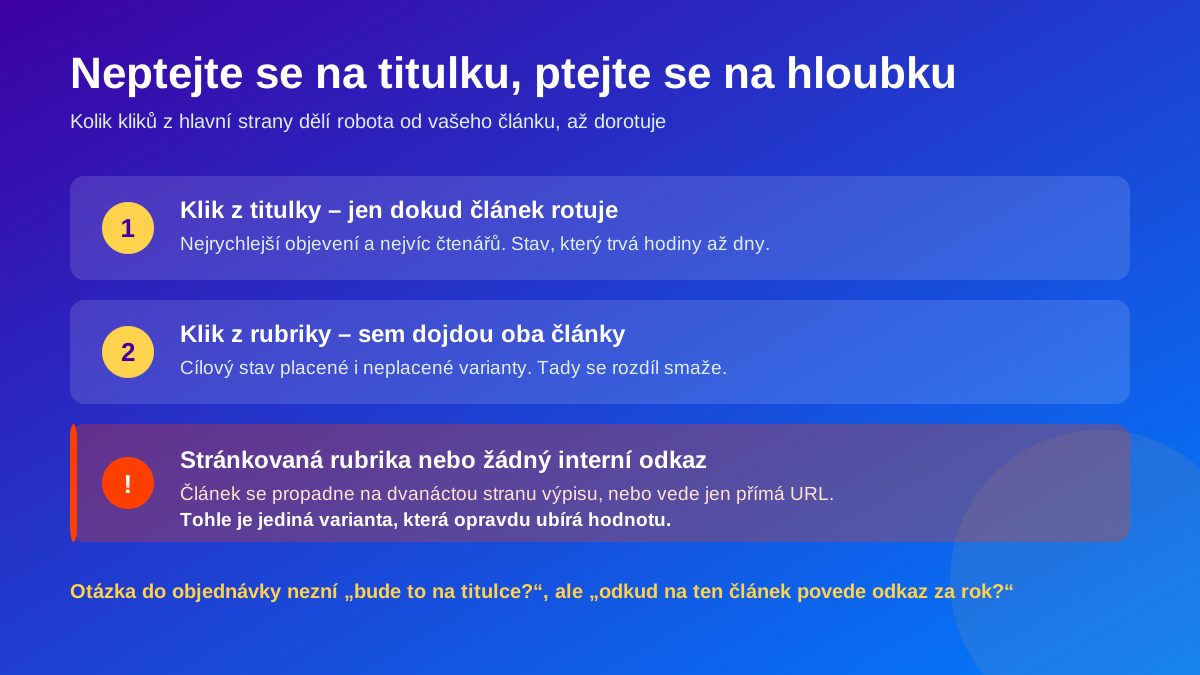
The real risk is not the front page but click depth
The cheaper variant has one form worth avoiding even with a discount – and it has nothing to do with the front page. It is an article you cannot click your way to from the site.
It happens in two ways. Either the section is paginated and your article sinks over months to the twelfth page of the listing, where the bot rarely goes. Or the medium publishes the article “outside the structure”: you get a URL, but no link leads to it from anywhere. Such a page is called orphaned and it is the most common reason content ends up outside the index.
The difference between “on the front page” and “in the section” is counted in days. The difference between “in the section” and “nowhere” is counted in the whole value of the order.
When paying extra for the front page is worth it
It is worth it when you buy reach in time: a product launch, a seasonal window, news you want somebody to pick up, or crisis communication. Also with titles that have weak organic traffic and practically all their readership comes from the front page – there an article in a section really is almost invisible.
It is not worth it when you buy a footprint in time: a brand mention, a link and a record that will still be written about in a year. All of that you get in the cheaper variant in the same quality. For the price difference you buy a publication in a second medium – and two mentions on two domains are consistently more valuable in the data than one mention placed higher.
Five questions to ask instead of “will it be on the front page?”
- How long will the article stay on the front page? Three hours and two days are two different services under the same name.
- Where does it end up afterwards? In the section, or outside the structure? Ask to see a specific older paid article and try to click your way to it from the front page.
- Is the section paginated? And on which page will the article end up after a year?
- Is the article in the sitemap? A simple check you can verify yourself.
- Will it stay published permanently? Deletion after twelve months cancels the whole investment regardless of how much you paid for the placement.
Summary in five sentences
- Text and link are identical in both variants. You are not paying for content, you are paying for a position in the layout.
- The difference lasts days, the price is one-off. After rotating off, both articles end in the same section.
- For AI visibility the surcharge is practically without effect. The model does not see the layout and domain authority decides.
- The front page pays for reach, not for a footprint. Launch and season yes, building mentions no.
- Watch the click depth, not the front page. An orphaned article is the only variant that truly subtracts value.
That is exactly why on the Linketica marketplace you see parameters and price for each title up front: you can compare whether the cheaper variant in a stronger medium is a better buy than the more expensive variant in a weaker one. Usually it is.
Časté otázky
Does an article without the front page have a weaker link?
Does it lower my chance of being cited by AI?
When is paying extra for the front page worth it?
What to ask the publisher instead?
What is an orphaned article?
Zdroje a doporučená literatura
- Chartbeat – Pageviews are down, but AI’s impact is complicated (data o návštěvnosti vydavatelů, 2026)
- Google Search Central – In-Depth Guide to How Google Search Works (objevování stránek po odkazech)
- Google Search Central – SEO Link Best Practices (crawlovatelné odkazy)
- SE Ranking – faktory citovanosti v ChatGPT (129 000 domén, 216 524 stránek)
- Muck Rack – What Is AI Reading? / Generative Pulse (květen 2026, 25+ mil. odkazů citovaných AI)
- Google Search Central – kvalifikace odkazů (rel="sponsored", "nofollow")
Zjistěte zdarma, jak vás vidí AI
Nechte jméno, e-mail a telefon a odemkneme vám online audit AI viditelnosti + checklist „Doporučuje vás AI?“ ke stažení.
Chcete rovnou nakupovat PR články a zmínky? Vyzkoušet Linketicu · Nezávazná poptávka na míru
Zadáním kontaktu souhlasíte s jeho použitím pro zpřístupnění auditu a zaslání tipů. Údaje nepředáváme dál. · Linketica.com