Roundup: What Changed in SEO and AI Visibility (August 2026)
For the first time, visibility in AI answers can be measured first-hand – Google and Microsoft have both released their own reports. At the same time another spam update is running and the European Commission has opened the question of whether the ban on self-preferencing extends to AI Overviews. We sum up four things with links to primary sources.
This text is the first of a regular series. Once every eight days we go through what has moved in SEO and visibility in AI answers, and sum up only what has a primary source – a tool maker’s announcement, documentation or an authority’s decision. Every item comes with a link, so it can be verified without us.
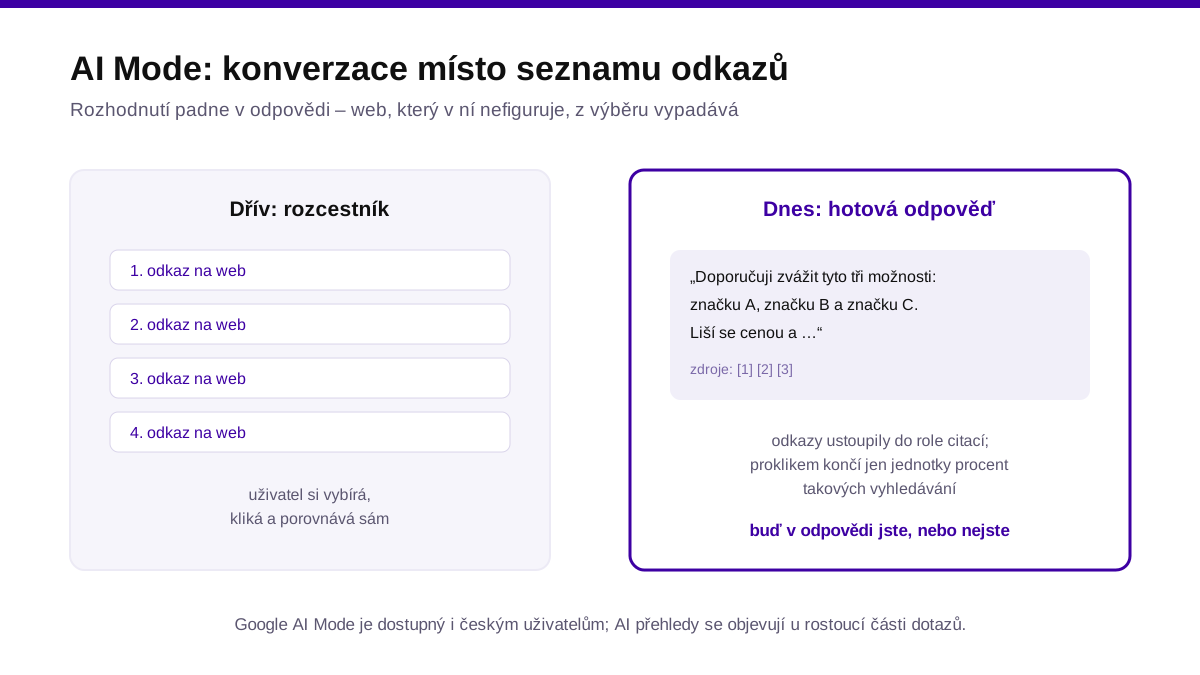
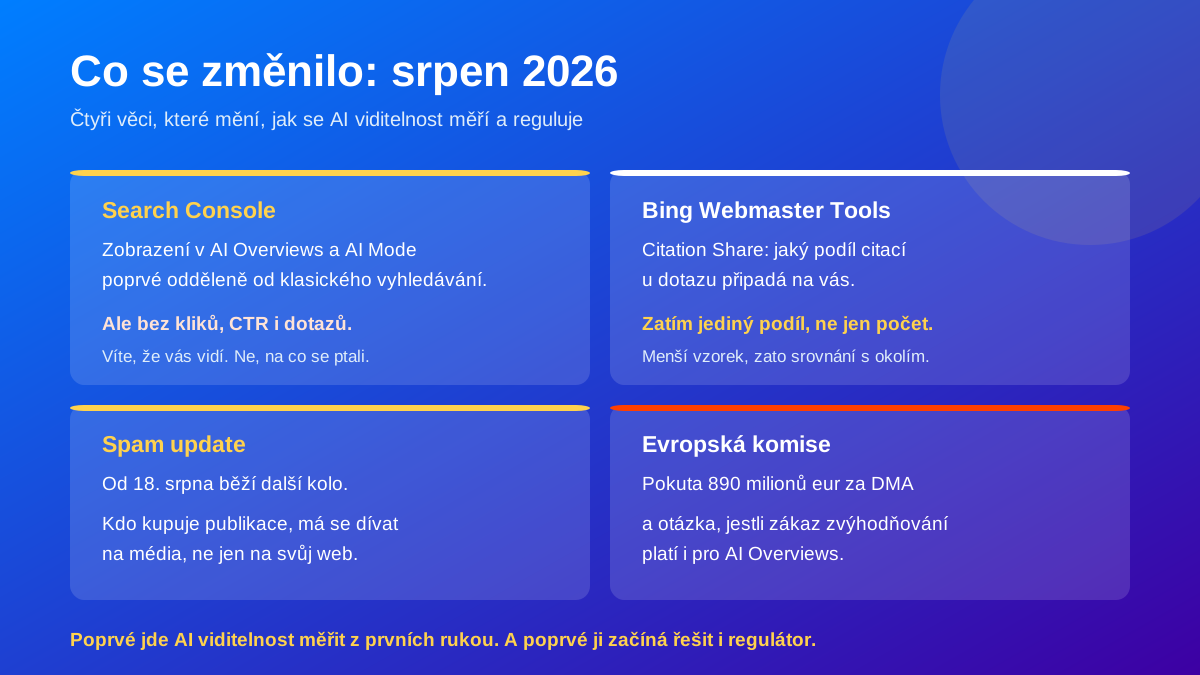
August 2026 brought four things and they all point the same way: AI visibility is ceasing to be an estimate. For two years it was measured by manually typing queries into chatbots. Now, for the first time, the operators themselves provide data on it – and at the same time the regulator is starting to take an interest.
1. Search Console shows impressions in AI Overviews and AI Mode
Google launched separate reports in Search Console for generative AI features: impressions of your URLs in AI Overviews, in AI Mode and in the AI features of Discover, separated from ordinary search. The data can be broken down by pages, countries and devices and grouped by days, weeks or months. During August the report appeared for a markedly larger number of websites than at the start.
More important than what the report shows is what it does not show: clicks, click-through rate and specific queries are missing. So you learn that the system displayed your page while assembling an answer – not what the user asked and whether they went further. For content planning that is a fundamental limitation, because it cannot be said which topics get you into the answers.
What to do with it practically: turn the report on and start collecting history even if you will not use it now. When Google adds clicks, you will have something to compare with. And compare the list of pages appearing in AI with the list of those that earn you money – they are often not the same ones.
2. Bing added Citation Share – the first share instead of a count
Microsoft released the AI Performance report in Bing Webmaster Tools back in February (the Grounding Queries and Citations metrics) and in June extended it with Intents, Topics, Compare and Citation Share. The last one is, from a measurement point of view, the most interesting thing this year: it says what share of the citations for a specific query fell to you.
All the other metrics we have today are absolute counts. But a count will not tell you whether you are visible well or badly in your niche – for that you need the surroundings. Citation Share is so far the only operator metric that provides them. Microsoft itself stresses it is an observational figure, not a ranking, which is a fair warning: it is not a score that can be optimized directly.
What to do with it practically: Bing has a fractional share in most European countries, so do not treat it as a traffic source. As a measuring instrument, though, yes – Copilot and ChatGPT stand on a related search layer, so a direction can be read from it that you will not see elsewhere.
3. Another spam update has been running since August 18
Google confirmed the rollout of the August spam update; its course can be seen on the Search Status Dashboard. As with every update of this type, the rippling of rankings takes weeks and evaluation is only possible after completion.
For whoever buys publications there is one specific thing: the risk mainly concerns the media, not your website. When a spam update hits a title in which you have a paid article, the publication loses value too – and you paid for it up front. We took it apart on the example of Cointelegraph in the article about buying links and mentions.
What to do with it practically: after every confirmed update, look at the traffic of the titles where you have paid placements, not just at your own rankings. With media that slump, there is no point buying further publications until they recover.
4. The European Commission: a €890 million fine and the AI Overviews question
On July 23, 2026, the Commission imposed a fine of €890 million on Google for violating the Digital Markets Act (DMA). It breaks down into 460 million for preferencing its own services in search results and 430 million for restricting app developers from pointing to cheaper ways to buy. Google got 60 days to remedy it.
More significant for us is the sentence that appeared in the decision alongside: the Commission stated it is focusing on how the ban on self-preferencing applies to AI Overviews and AI Mode and plans to keep discussing it with Google. Separately, an antitrust investigation is running into whether Google fairly rewards publishers for the content and YouTube videos it uses to train models, and whether it gives them the option to refuse.
What to do with it practically: nothing that could be done today. But it is the first signal that the rules for AI answers will be negotiated – and that publishers are not without leverage in it. Whoever sells media space should watch it.
What it adds up to
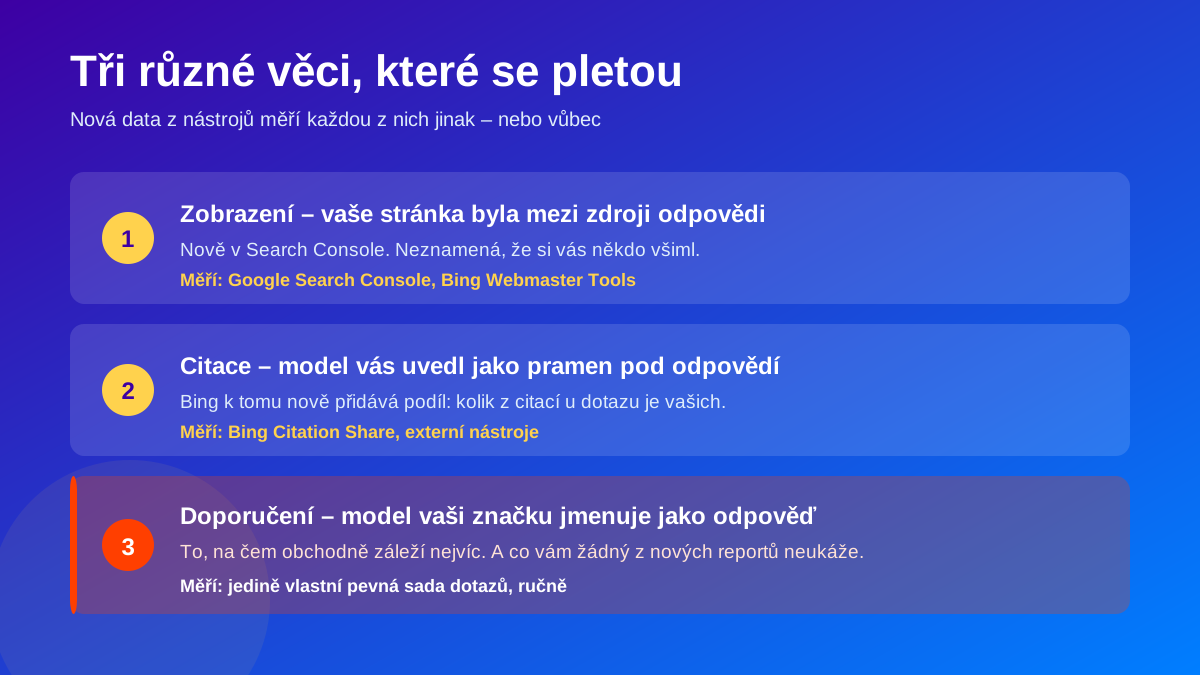
The new reports are good news, but they invite one mistake. They measure two things, and the commercially most important one is not among them:
- Impression – your page was among the sources the answer was assembled from. This is what Search Console newly provides.
- Citation – the model listed you as a source under the answer. This is what Bing measures, newly also as a share.
- Recommendation – the model names your brand as the answer to a question like “who is good for this”. Neither of the new reports will show you this.
That these are not synonyms is shown by data too: according to the Semrush AI Visibility Index, the set of mentioned brands and cited domains overlaps from 64% for Google AI Overviews down to a mere 30% for Gemini. One can thus be a cited website and an unrecommended brand – and vice versa.
The practical conclusion is boring but still holds: turn the new reports on, but do not cancel your own measurement. A fixed set of twenty to thirty queries from your niche, asked once a month, is still the only way to find out whether the models name you. The new tools add context to it; they do not replace it.
Summary in four sentences
- Search Console shows impressions in AI, but without clicks and without queries.
- Bing added a share of citations – the first metric that also shows the surroundings.
- A spam update is running; watch the titles where you have paid placements, not just your own website.
- Regulation has arrived at AI answers and publishers have a say in it.
The next roundup comes out in eight days. If you are interested in what this means for media selection, on the Linketica marketplace you see parameters and price for every title up front – including how it fares over time.
Časté otázky
Does Search Console show how many people clicked through to me from an AI answer?
What is Citation Share in Bing Webmaster Tools for?
What does the August spam update mean for purchased publications?
Does the European Commission fine also concern AI Overviews?
How often does this roundup come out?
Zdroje a doporučená literatura
- Google Search Central – Introducing Search generative AI performance reports in Search Console (červen 2026)
- Bing Webmaster Tools – AI Performance report (Citation Share, Intents, Topics)
- Google Search Status Dashboard – přehled probíhajících aktualizací vyhledávání
- Evropská komise – Commission fines Google €890 million for breaches of the Digital Markets Act (23. 7. 2026)
- Google Search Central – AI features and your website (AI Overviews, AI Mode)
- Semrush – AI Visibility Index 2026 (126 mil. promptů, leden–duben 2026)
Zjistěte zdarma, jak vás vidí AI
Nechte jméno, e-mail a telefon a odemkneme vám online audit AI viditelnosti + checklist „Doporučuje vás AI?“ ke stažení.
Chcete rovnou nakupovat PR články a zmínky? Vyzkoušet Linketicu · Nezávazná poptávka na míru
Zadáním kontaktu souhlasíte s jeho použitím pro zpřístupnění auditu a zaslání tipů. Údaje nepředáváme dál. · Linketica.com